
How to Prove Security Guard Patrol Completion to Clients
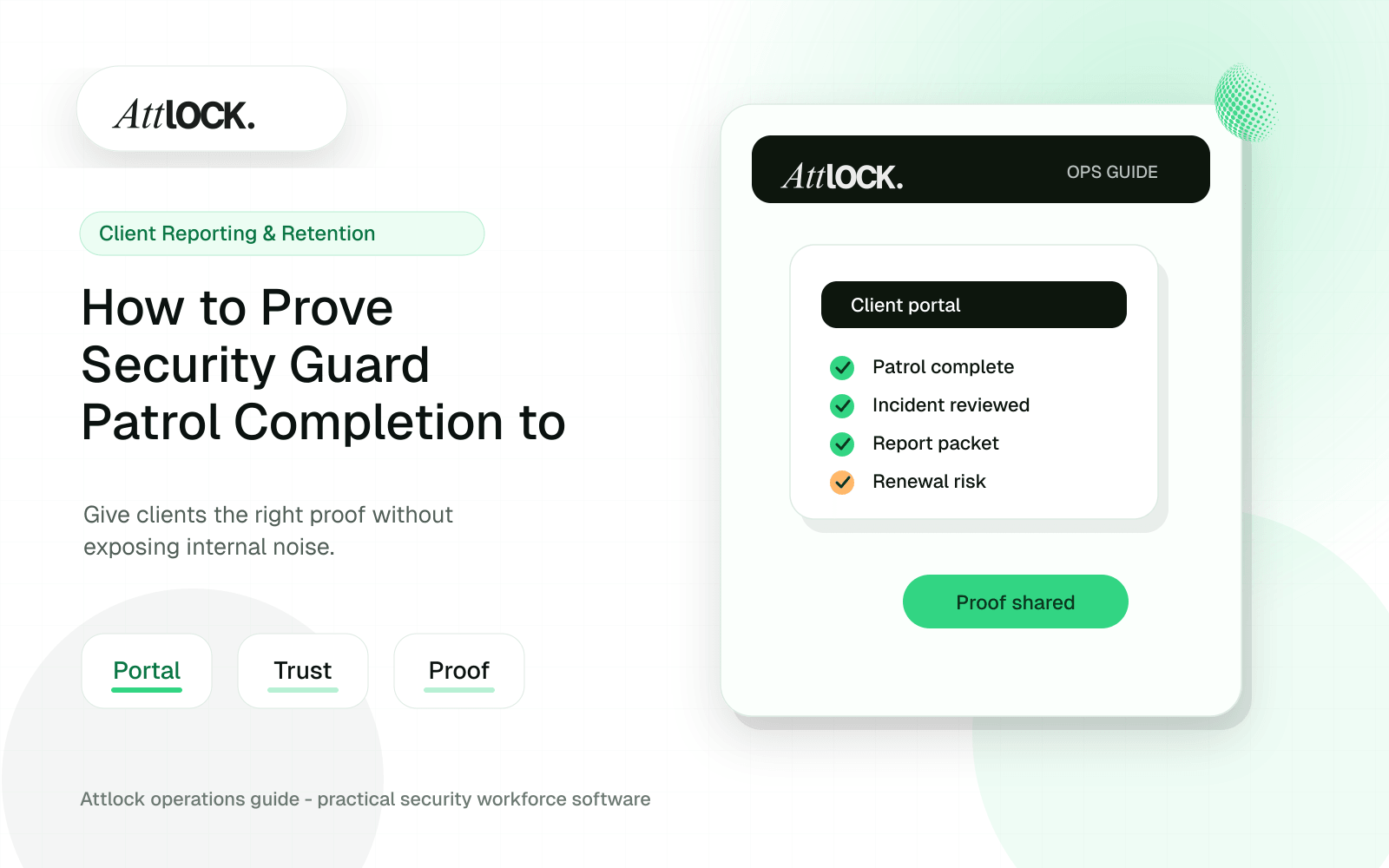
Table of Contents
- Patrol Proof Packet Toolkit
- What Counts As Patrol Proof
- Proof Packet Structure
- Checkpoint Completion Table
- Exception Handling Checklist
- Client-Facing Proof Example
- Account Manager Workflow
- Questions Clients May Ask
- The Patrol Proof Stack
- Common Proof Gaps
- Monthly Patrol Report Structure
- Operator Scenario: Renewal Defense
- Where Attlock Fits
- A Practical Rollout Plan
- FAQ
- What is proof of service in security?
- Can patrol proof help with renewals?
- Should clients see every checkpoint scan?
- How should missed patrols be handled?
- Operational Rollout Notes
- Configuration Table
- Related Attlock Workflows
Share Article
Patrol Proof Packet Toolkit
Patrol proof should show more than a completed checklist. A strong proof packet connects checkpoint activity, time, location, guard notes, exceptions, supervisor review, and client follow-up in one clean record.
What Counts As Patrol Proof
| Proof item | Purpose |
|---|---|
| Checkpoint scan | Shows the guard reached a required location |
| Timestamp | Shows when the checkpoint was completed |
| GPS or map context | Adds location context where available |
| Photo | Supports a condition or exception |
| Guard note | Explains what was observed |
| Exception reason | Explains missed, delayed, or inaccessible checkpoints |
| Supervisor review | Shows management oversight |
Proof Packet Structure
- Site and shift details.
- Patrol route name.
- Guard assigned.
- Checkpoint completion table.
- Exceptions and explanations.
- Photos or attachments.
- Supervisor review status.
- Client-facing summary.
- Follow-up items.
Checkpoint Completion Table
| Checkpoint | Scheduled window | Completed | Notes |
|---|---|---|---|
| Main entrance | 2100-2130 | 2112 | Secure |
| Loading dock | 2100-2130 | 2118 | Door 4 closed |
| East fence | 2100-2130 | 2126 | Light out near pole E-4 |
| Employee lot | 2100-2130 | Missed | Area blocked by emergency repair crew; supervisor reviewed |
Exception Handling Checklist
- Mark the checkpoint as missed, delayed, or inaccessible.
- Explain the reason in plain language.
- Add a photo if it helps.
- Notify the supervisor when required.
- Record whether the patrol was resumed.
- Include the exception in the client-facing summary.
- Avoid hiding exceptions inside generic completion reports.
Client-Facing Proof Example
| Field | Example |
|---|---|
| Patrol route | Exterior Night Patrol |
| Shift | May 14, 2200 to 0600 |
| Result | 11 of 12 checkpoints completed |
| Exception | Employee lot checkpoint inaccessible at 2318 due to emergency repair crew blocking the area |
| Supervisor review | Note and photo reviewed |
| Follow-up | Client facilities team to confirm access procedure during emergency repairs |
Account Manager Workflow
- Review patrol proof before the client asks for it.
- Compare exceptions against post orders.
- Confirm supervisor review is complete.
- Prepare a short client summary with the proof packet attached.
- Identify repeated missed checkpoints.
- Convert recurring exceptions into a route, staffing, or site-access discussion.
Questions Clients May Ask
| Client question | Useful answer |
|---|---|
| How do I know the patrol happened? | Show checkpoint timestamps and route history |
| What happened when a checkpoint was missed? | Show the exception reason and supervisor review |
| Can we see patterns? | Summarize repeated exceptions by checkpoint and shift |
| Can this be shared with our team? | Provide a client-facing proof packet without internal-only notes |
The Patrol Proof Stack
| Layer | What it proves | Why clients care |
|---|---|---|
| Scheduled coverage | The patrol was required during a defined shift | Confirms the company knew the obligation |
| Guard identity | A specific guard performed the work | Creates accountability |
| Checkpoint or route record | Required areas were visited | Shows service completion |
| GPS/geofence context | The guard was at or near the site | Adds location confidence |
| Incident and exception notes | Problems were documented | Explains gaps and follow-up |
| Supervisor review | The record was checked before sharing | Improves trust and professionalism |
Common Proof Gaps
Many companies already have the data but cannot present it cleanly. The schedule is in one place, checkpoint scans are in another, incident photos sit on a phone, and the client report is built manually. When the client asks for proof, the account manager has to reconstruct the shift instead of sending a reviewed record.
| Gap | Client reaction | Fix |
|---|---|---|
| Raw scan export only | Hard to understand value | Summarize completion, exceptions, and response |
| GPS without required route | Shows movement but not obligations | Connect GPS to scheduled checkpoints |
| No supervisor review | Client questions accuracy | Approve reports before release |
| No missed patrol explanation | Looks like negligence | Require exception notes and follow-up status |
Monthly Patrol Report Structure
- Coverage summary: scheduled shifts, completed patrols, and exception count.
- Patrol completion: required routes, completed checkpoints, missed checkpoints, and reasons.
- Incident activity: notable reports, response actions, photos, and close-out status.
- Recurring issues: doors, trespass areas, maintenance risks, alarms, or policy violations.
- Recommendations: operational changes, client actions, or site improvements.
Operator Scenario: Renewal Defense
A client questions whether overnight patrols are worth the contract cost. The account manager brings a report showing 96 completed patrols, two missed checkpoints with documented reasons, four trespass interventions, three maintenance issues discovered, and supervisor-reviewed photos. That record turns a price conversation into a service value conversation.
Proof also needs a cadence. A client may not want a full patrol report every morning, but they should not hear about service quality only during a dispute. Many companies use a weekly exception summary and a monthly proof-of-service report. The weekly view catches missed patrols, repeated access issues, or incident patterns while they are still fixable. The monthly view helps account managers explain value, recommend site improvements, and prepare for renewal conversations.
The strongest proof process also protects guards. When patrol expectations are clear and exceptions can be documented, a guard is not left defending a missed checkpoint from memory days later. The record shows the route, timing, conditions, notes, and supervisor response, which is fairer for both the company and the field team.
Where Attlock Fits
Attlock helps companies prove patrol completion by connecting the patrol record to the schedule, guard, site, post orders, GPS context, incidents, and client reporting. The platform is designed to turn field activity into reviewed proof rather than leaving managers to assemble evidence manually.
Attlock is not just a reporting skin over raw scans. It works best when the company wants patrol proof to support client trust, supervisor accountability, and contract retention.
A Practical Rollout Plan
- Week 1: audit the current patrol completion proof workflow, list the sites affected, and decide which records must be client-ready.
- Week 2: configure one active site with real guards, post orders, patrol requirements, notification rules, and supervisor ownership.
- Week 3: run the workflow during live shifts and measure missed steps, manual edits, supervisor review time, and client questions.
- Week 4: expand only after the pilot proves that guards can use the mobile workflow and managers can review the records without cleanup.
FAQ
What is proof of service in security?
Proof of service is the record showing that contracted security work was performed. For patrols, that usually includes scheduled coverage, guard identity, timestamps, checkpoint activity, location context, incident notes, and supervisor review. The strongest proof is clear enough for a client to understand quickly.
Can patrol proof help with renewals?
Yes. Patrol proof helps account managers show the value delivered during the contract, especially when the site had incidents, recurring risks, or frequent patrol requirements. Clean reports make the service visible before renewal becomes only a price discussion.
Should clients see every checkpoint scan?
Usually no. Clients often need summarized, reviewed proof rather than every raw scan. Show completion rates, missed patrol explanations, incidents, trends, and recommendations. Raw data can be available when needed, but the standard report should tell a clear service story.
How should missed patrols be handled?
Missed patrols should be documented, reviewed, and explained. The record should show what was missed, why it happened, whether the guard or supervisor took corrective action, and whether the client needs follow-up. Silence creates more risk than a clear exception record.
Operational Rollout Notes
A patrol workflow should show more than a completed route. Supervisors need to know what was scheduled, what was actually checked, what was missed, and what evidence is strong enough to share with the client.
Configuration Table
| Workstream | What to configure | Owner |
|---|---|---|
| Route design | Checkpoint order, required notes, photos | Operations manager |
| Field proof | GPS context, NFC or QR scan, timestamp | Guard or supervisor |
| Exceptions | Missed, late, skipped, or repeated checkpoints | Field supervisor |
| Client output | Route summary with exceptions and attachments | Account manager |
Related Attlock Workflows
In Attlock, this connects naturally to guard tour system, live tracking, and client portal so the article turns into an operating workflow instead of a static note.