Attlock vs Silvertrac: Full 2026 Comparison
Table of Contents
- When Guard Tour Software Is No Longer Enough
- What Silvertrac Does Well — and Where It Stops
- Guard Tour and Checkpoint Scanning
- Incident and Activity Reporting
- The Limits of a Specialized Tool
- Attlock vs Silvertrac: A Feature-by-Feature Breakdown
- Patrol Verification — NFC, QR, and GPS Triple Verification
- Incident Reporting
- Live Command Center and Dispatch
- Smart Scheduling
- Geofenced Time and Attendance
- Real-Time Client Portal
- Billing and Invoicing
- The Hidden Cost of Fragmented Tools
- Pricing — Per-Site, Not Per-Guard
- Choosing the Best Guard Tour System for 2026
- Operational Rollout Notes
- Configuration Table
- Supervisor Checklist
- Related Attlock Workflows
- FAQ
- What should buyers test before using this workflow?
- How should teams measure success?
Share Article
When Guard Tour Software Is No Longer Enough
Security company owners evaluating software in 2026 face a persistent question: do you buy a specialized guard tour tool, or invest in a platform that manages your entire operation? That question becomes concrete when comparing Silvertrac — one of the most recognized names in security patrol software — against newer, more comprehensive alternatives. Silvertrac has earned its reputation in guard tour verification and incident reporting. But the security industry has evolved. Today's security firms need scheduling, dispatch, live client visibility, geofenced time and attendance, and integrated billing running in one unified system. When those functions are spread across multiple disconnected tools, you pay for it in administrative overhead, data re-entry errors, and service gaps that clients notice. This comparison breaks down exactly what each platform delivers — and what that means for your day-to-day operations in practice.
What Silvertrac Does Well — and Where It Stops
Guard Tour and Checkpoint Scanning
Silvertrac's core strength is in guard tour management and checkpoint verification. The platform helped security companies move away from paper patrol logs by digitizing checkpoint scans and generating basic proof-of-service records. Guards document their tours, supervisors review scan activity, and clients receive confirmation that patrols occurred. For single-site operations with straightforward patrol routes and no complex operational requirements, Silvertrac has historically provided a workable foundation for checkpoint accountability.
Incident and Activity Reporting
Silvertrac also supports incident reporting and daily activity logs. Guards submit reports from the field, supervisors review them, and records are stored for client delivery. These workflows cover the documentation side of basic security operations. For companies that need a simple incident paper trail alongside patrol logs, the combination works. These are table-stakes capabilities — but they are also where Silvertrac's feature set largely plateaus for growing security operations that need more than a patrol log.
The Limits of a Specialized Tool
The challenge is not what Silvertrac does — it is what it does not do, and how much work that creates for your management team. Scheduling guards across multiple sites, managing shift conflicts, verifying clock-ins with GPS, tracking overtime, generating invoices from hours worked, giving clients live visibility into their coverage, and dispatching guards to incidents in real time all fall outside Silvertrac's core platform. Security companies using Silvertrac as their primary operations tool typically build a stack of supplementary tools around it: a scheduling app, a payroll system, a separate billing tool, an email chain for client updates. Each additional tool introduces another point of failure, another data entry requirement, and another monthly subscription fee.
Attlock vs Silvertrac: A Feature-by-Feature Breakdown
Patrol Verification — NFC, QR, and GPS Triple Verification
Both platforms provide checkpoint scanning, but the verification architecture differs significantly. Attlock uses a triple-verification model combining NFC tags, QR codes, and GPS confirmation on every single scan. Each checkpoint event creates an immutable audit record: the guard taps the checkpoint, GPS coordinates are captured, a timestamp is sealed, and the event syncs live to the command center. There is no way to fabricate a scan from across a parking lot. Missed checkpoints trigger instant supervisor alerts, and the live patrol feed provides real-time visibility into exactly where every guard is in their tour at any given moment. Across Attlock-powered operations, this system produces a 93% average patrol adherence rate — a metric that speaks directly to the quality of service security companies can deliver to clients and document for compliance purposes.
Incident Reporting
Attlock's incident reporting module covers six incident types — panic, theft, medical, fire, trespass, and vandalism — across four priority levels: critical, high, medium, and low. Guards attach multimedia evidence including photos, video, and audio, all GPS-tagged at the moment of submission. Automatic escalation rules route each incident based on type and priority without requiring manual supervisor intervention. The full incident lifecycle — reported, escalated, in progress, resolved, closed — is documented and audit-ready for insurance claims, legal proceedings, and compliance reviews. Guards complete incident reports in under one minute, compared to the 45-minute average for manual paper documentation. That difference, across a team of guards submitting multiple reports per week, compounds into substantial administrative savings and meaningfully faster client communication.
Live Command Center and Dispatch
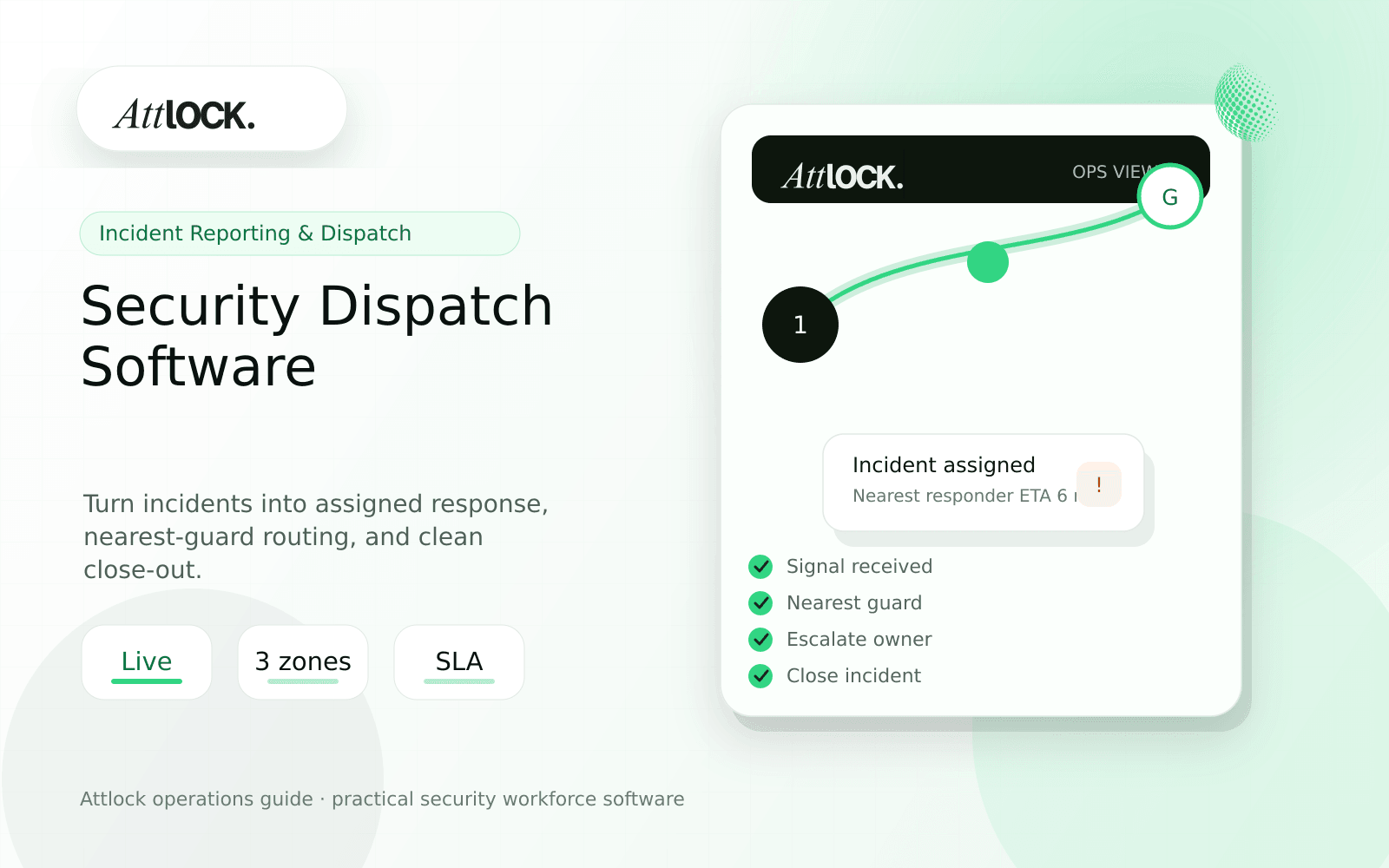
This is where the capability gap between the two platforms becomes most pronounced. Silvertrac's patrol-focused architecture does not include a real-time dispatch command center. Attlock's Live Command Center displays every on-duty guard's GPS position on a live operations map. Supervisors assign guards to incidents with a single click, fleet vehicles are marked in use when deployed, and each dispatch ticket tracks automatically through dispatched, en route, on scene, and completed — with timestamps logged at every transition. Panic alerts, missed checkpoint notifications, and incident escalations all surface in the same command view, giving dispatchers a single screen to manage everything happening across all sites simultaneously. Response times are recorded automatically, creating a full audit trail of every dispatch decision your team makes.
Smart Scheduling
Attlock's scheduling module reduces schedule-building time by 80% compared to manual methods. The platform includes real-time conflict detection that flags double-bookings, rest-period violations, and certification mismatches before a schedule is ever published — problems that fall entirely outside Silvertrac's scope. Shift templates allow managers to save and reuse common patterns across sites. Week and day calendar grid views give a clear picture of coverage gaps and overtime exposure at a glance. Open shift management and guard-initiated swap requests with admin approval workflows handle the scheduling flexibility that security operations require every single week. One-click publish sends instant push notifications to all affected guards. For security companies managing multiple sites and dozens of guards, this capability alone eliminates hours of administrative work every week.
Geofenced Time and Attendance
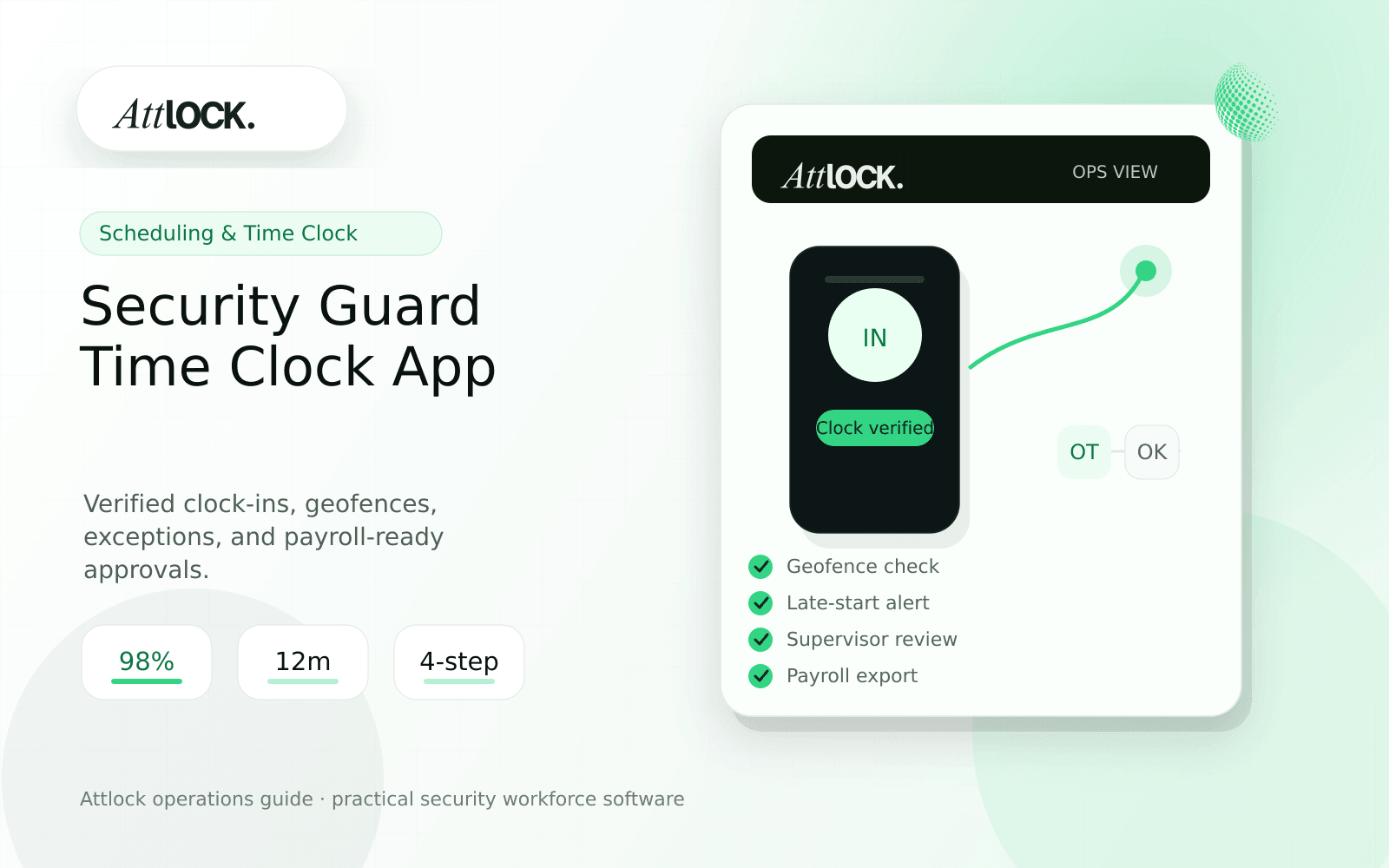
Attlock eliminates buddy punching at the system level. Guards must be physically inside the site's geofence to clock in — GPS coordinates and device IDs are captured and logged with every clock event. Three clock-in methods are available: mobile app, web dashboard, and supervisor-assisted entry. Automated timesheet generation pulls directly from verified GPS clock data, removing any manual reconciliation step entirely. Late and no-show alerts fire on configurable windows, break tracking handles paid and unpaid categorization, and real-time overtime alerts prevent surprise payroll costs from accumulating mid-shift. One-click payroll export connects directly to ADP, Gusto, and QuickBooks. Silvertrac does not include geofenced time and attendance functionality, which means security companies using Silvertrac are managing attendance verification and payroll processing in completely separate systems.
Real-Time Client Portal
Attlock's client portal gives facility managers and corporate clients a live, read-only view of their security coverage — real-time guard positions on a site map, a live activity feed, shift performance ratings, and a self-service service request portal. Clients who previously called their security provider multiple times per shift to verify coverage stop doing so. Security companies using Attlock report a 50% reduction in client check-in calls after deploying the portal. Clients see exactly what is happening, when it is happening, and receive branded PDF reports on automated delivery schedules — daily, weekly, or monthly. The portal reduces communication overhead on your operations team while simultaneously strengthening client trust and retention. Silvertrac provides basic client reporting but does not offer a live portal with real-time guard position visibility.
Billing and Invoicing
Attlock auto-generates invoices directly from tracked hours, supporting per-guard, per-site, and per-shift-type billing rates with flexible structures including hourly, flat-rate, and overtime multipliers. Stripe payment processing handles credit card, ACH, and bank transfers with PCI-compliant security. Automatic recurring invoices manage fixed-rate contracts without manual intervention each billing cycle. Payroll integration with ADP, Gusto, and QuickBooks closes the loop between hours worked and compensation paid. For security companies currently managing invoicing and payroll in separate systems alongside Silvertrac, consolidating billing into the same platform that tracks hours, checkpoints, incidents, and patrols eliminates an entire category of administrative work — along with the billing errors that arise whenever data crosses system boundaries.
The Hidden Cost of Fragmented Tools
Security companies that build operations on specialized single-function tools pay a hidden tax that does not appear on any one line item. Data that should flow automatically gets re-entered manually. Scheduling conflicts that a unified system would catch in real time get discovered after a guard fails to show up. Payroll takes longer because hours must be reconciled across systems. Client calls pile up because there is no self-service visibility tool. Billing disputes require pulling records from three different platforms. And when an incident escalates to an insurance claim or legal proceeding, assembling a complete audit trail from fragmented sources is slow, stressful, and sometimes incomplete at exactly the moment it needs to be airtight.
The unified platform model that Attlock is built on eliminates this operational friction entirely. One system captures every clock-in, every checkpoint scan, every incident report, every dispatch action, every shift hour, and every client interaction. That single database powers automated billing, compliance documentation, and client transparency simultaneously — without anyone manually moving data between tools. The result is an operation that runs faster, documents better, and costs significantly less to administer as it scales.
Pricing — Per-Site, Not Per-Guard
Attlock uses per-site pricing with unlimited guards included at every plan tier. The Starter plan begins at $40 CAD per site per month. Professional is $99 CAD per site per month. Enterprise is $249 CAD per site per month. No hidden fees, and a free trial is available. This pricing model directly benefits security companies as they grow their workforce — adding guards to a site does not increase your subscription cost. For companies managing multiple sites with varying guard counts, the Attlock pricing structure is highly predictable as operations scale. Silvertrac's pricing model includes per-user or per-device components that scale with headcount, making total cost of ownership harder to forecast and more expensive to manage as your team grows.
Choosing the Best Guard Tour System for 2026
If your security operation is a single site focused purely on basic patrol logging, a narrowly scoped tool may appear adequate. But if you are running multiple sites, managing a team of guards, invoicing clients, coordinating dispatch responses, and trying to give corporate clients real-time visibility without spending half your day fielding check-in calls — a guard tour module alone is not the right foundation for your business.
The best guard tour system for 2026 is one that makes patrol verification part of a complete operational picture. That means live dispatch running alongside patrol alerts, GPS-verified time and attendance alongside checkpoint scanning, automated billing alongside shift reports, and client transparency built into the same platform as your compliance documentation — all from one system, on one dashboard, without stitching tools together and hoping the seams hold.
Security companies that have moved to Attlock from fragmented tool stacks consistently report the same outcomes: 80% less time building schedules, 50% fewer client check-in calls, a 93% patrol adherence rate, and incident reports that drop from 45 minutes to under 5. These results do not come from optimizing individual point solutions — they come from running the entire operation from a single unified platform that was purpose-built for the security industry.
If you are evaluating Silvertrac alternatives and want to see what a full-platform approach looks like in practice, book a demo at attlock.com/book-demo. Attlock's team will walk you through every module relevant to your specific operation — from patrol verification and live dispatch to automated billing and the real-time client portal — so you get a clear, honest picture of what your business looks like when everything runs on one system.
Operational Rollout Notes
A patrol workflow should show more than a completed route. Supervisors need to know what was scheduled, what was actually checked, what was missed, and what evidence is strong enough to share with the client.
Configuration Table
| Workstream | What to configure | Owner |
|---|---|---|
| Route design | Checkpoint order, required notes, photos | Operations manager |
| Field proof | GPS context, NFC or QR scan, timestamp | Guard or supervisor |
| Exceptions | Missed, late, skipped, or repeated checkpoints | Field supervisor |
| Client output | Route summary with exceptions and attachments | Account manager |
Supervisor Checklist
- Build routes around real risk areas, not just convenient scan points.
- Test the route after dark and during poor signal conditions.
- Require exception reasons for missed checkpoints.
- Separate supervisor review from client publishing.
- Compare GPS context with scan proof before promising accuracy.
- Review recurring missed points during weekly operations meetings.
Related Attlock Workflows
In Attlock, this connects naturally to guard tour system, live tracking, and client portal so the article turns into an operating workflow instead of a static note.
FAQ
What should buyers test before using this workflow?
Test one real site, one real guard workflow, one supervisor exception, and one client-ready output. If the process only works in a clean demo, it will create cleanup work after rollout.
How should teams measure success?
Measure whether supervisors can act faster, records are easier to review, clients receive clearer proof, and administrative cleanup drops after the first month.