The $500K Leak: True Cost of Legacy Guard Management Software
Table of Contents
- Key Takeaways
- Your P&L Has a Hole You Can't See
- Cost Center #1: Scheduling Waste — $93K+ Per Year
- Cost Center #2: Buddy Punching & Time Theft — $260K+ Per Year
- Cost Center #3: SLA Penalties & Contract Risk — $180K+ Per Year
- The Visibility Problem
- Cost Center #4: Billing Leakage — $130K+ Per Year
- Cost Center #5: Compliance Exposure — Uncapped Risk
- The TCO Comparison: Attlock vs. TrackTik at Enterprise Scale
- The Payback Period Math
- Why Enterprise Operators Are Leaving TrackTik Now
- The Contrarian Take: Your Software Isn't the Expense — Your Manual Processes Are
- Frequently Asked Questions
- How much does enterprise security guard management software cost?
- What is the ROI of switching from TrackTik to Attlock?
- How long does it take to deploy Attlock at enterprise scale?
- How does per-site pricing compare to per-guard pricing for large security companies?
- What compliance requirements does enterprise security software need to meet?
Share Article
TL;DR
A 500-guard security operation running on legacy tools or fragmented software bleeds $500K+ per year across five cost centers: scheduling waste ($93K), buddy punching ($260K), SLA penalties ($180K), billing leakage ($130K+), and uncapped compliance exposure. Attlock replaces 5+ tools at ~$6,500 CAD/month for 100 sites vs. TrackTik's $20K+/month — with a payback period under 6 weeks.
Key Takeaways
- A typical 500-guard, 100-site operation loses $500K+ annually across five hidden cost centers: scheduling waste, time theft, SLA penalties, billing leakage, and compliance exposure.
- Per-guard pricing models like TrackTik's punish growth — at 100 sites, expect $20K+/month vs. Attlock's ~$6,500/month for the same coverage.
- Buddy punching alone costs enterprise operators $260K+/year, and most legacy platforms lack geofenced verification to stop it.
- Attlock's per-site pricing, 1-2 week deployment, and unified platform deliver a payback period under 6 weeks for most enterprise operators.
- Transparent pricing is a trust signal — if your vendor won't show you costs before a sales call, ask yourself what they're hiding.
Your P&L Has a Hole You Can't See
Picture this: It's the last Friday of the month. Your finance team is reconciling invoices against timesheets against scheduling records — three different systems, three different versions of the truth. Your regional managers spent the week chasing overtime overruns they didn't approve. Your ops director just learned that a client is withholding payment over a missed patrol that nobody flagged. And somewhere in payroll, 30-40 guards clocked in for shifts they never physically attended.
This isn't a worst-case scenario. This is a normal month for most 500-guard security operations running on legacy tools. The losses don't show up as a single line item — they're spread across scheduling inefficiency, time theft, penalty clauses, billing errors, and compliance gaps. Individually, each one looks manageable. Together, they drain more than $500,000 per year from your bottom line.
We built Attlock to make these losses visible — and then eliminate them. What follows is a forensic breakdown of the five cost centers bleeding enterprise security companies dry, with real dollar formulas you can plug your own numbers into. If you're a CFO evaluating a platform switch, or a VP of Operations trying to build the internal case for change, this is the ammunition you need.
Cost Center #1: Scheduling Waste — $93K+ Per Year
Your regional managers are not schedulers. They're experienced operations people whose job is to ensure coverage, manage client relationships, and solve problems. But in a 100-site operation running on spreadsheets or disconnected scheduling tools, they spend 10-15 hours per week on manual schedule adjustments, overtime reconciliation, and shift-fill phone calls.
Let's do the math. A regional manager costs roughly $60-$75K/year fully loaded. If 25-30% of their time goes to scheduling grunt work, that's $18K-$22K per manager per year in zero-value labor. Multiply across 4-5 regional managers in a 500-guard operation and you're looking at $93K+ annually — producing nothing billable.
80%
Scheduling Time Reduction
Attlock's smart scheduling with conflict detection and instant notifications
The waste compounds. Manual scheduling means more double bookings, more coverage gaps, more overtime surprises. Every unplanned overtime hour at time-and-a-half eats directly into your margin. Attlock's smart scheduling engine catches conflicts before they happen, handles shift swaps with instant notifications, and reduces scheduling time by 80%. That's not a projection — it's a measured result across 150+ companies.
💡 Quick formula for your operation: (Number of regional managers) × (hours/week on scheduling) × (hourly loaded cost) × 52 weeks = your annual scheduling waste. Most 100-site operators land between $80K-$120K.
Cost Center #2: Buddy Punching & Time Theft — $260K+ Per Year
Here's the number nobody wants to say out loud: the American Payroll Association estimates that buddy punching costs employers 2-5% of gross payroll. At a 500-guard operation with an average fully-loaded guard cost above $22/hour, you're looking at gross payroll in the range of $20-$23 million annually. Even at the conservative 2% end, that's $400K+ per year walking out the door.
Let's be generous and assume your supervisors catch some of it. Call it a net loss of $260K annually. That's still a quarter million dollars paid for hours nobody worked. And if you're using a legacy time-and-attendance system without GPS verification, you have zero proof it isn't happening right now.
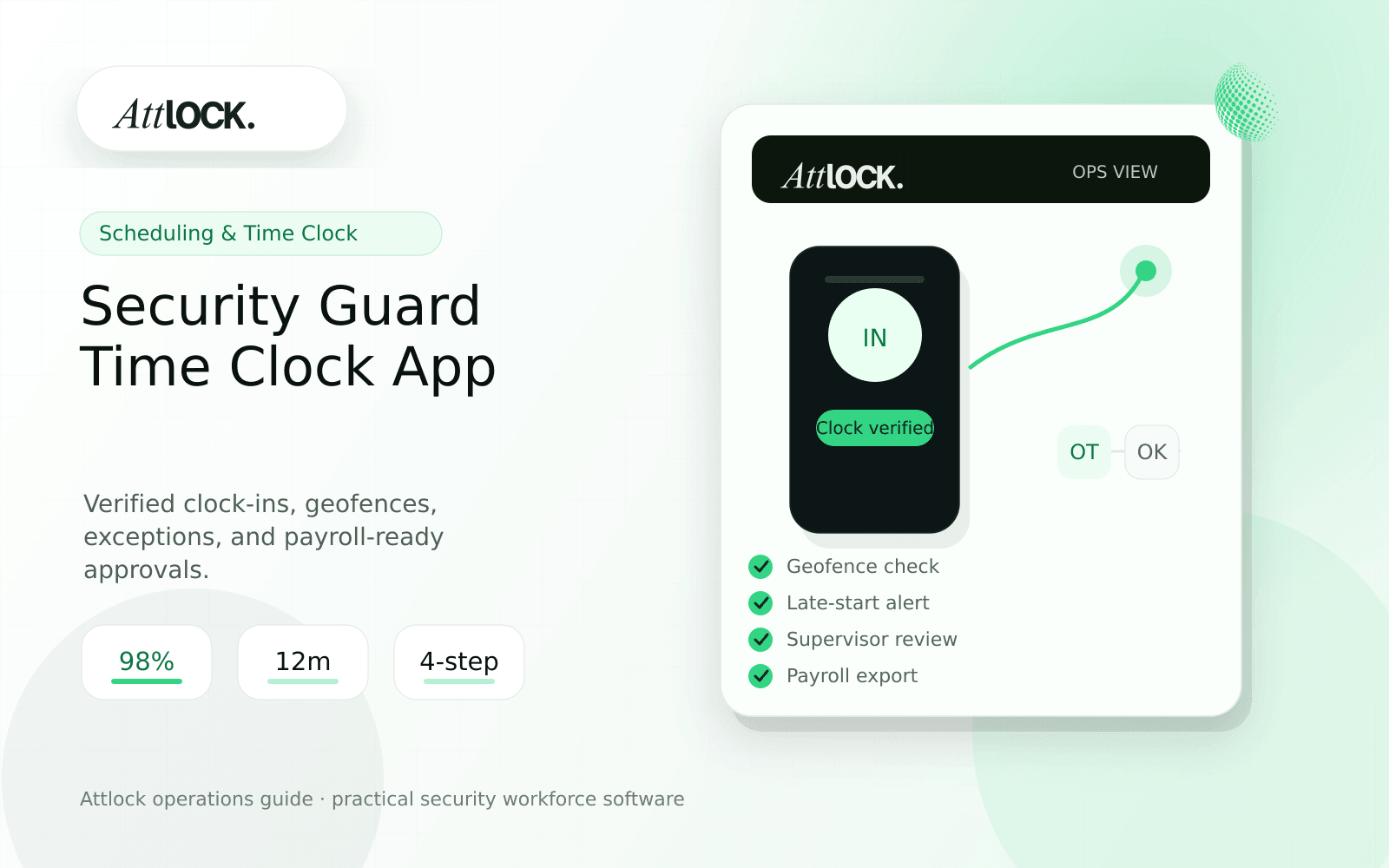
Attlock's geofenced time and attendance eliminates this entirely. Guards clock in and out with GPS-verified location data. No proximity to the site, no clock-in. The system exports automated timesheets directly to ADP, Gusto, or QuickBooks — no manual reconciliation, no ambiguity. Buddy punching drops to zero.
You wouldn't accept a 2-5% shrinkage rate in retail inventory. Why accept it in labor — your single largest expense?
Cost Center #3: SLA Penalties & Contract Risk — $180K+ Per Year
Enterprise security operators manage 8-15 client SLA frameworks simultaneously across regions. Each one has its own checkpoint requirements, response time expectations, incident reporting windows, and penalty clauses. A single missed checkpoint or late incident report can trigger penalties of $500-$5,000 per occurrence.
Across a 100-site portfolio, those penalties accumulate fast. Operators we've spoken with estimate $180K+ annually in SLA penalty exposure — and that's before counting the contracts lost entirely because clients had no visibility into guard performance.
The Visibility Problem
Here's what makes this worse: most legacy platforms don't give your clients any real-time data. So they call. Every day. Your ops team fields dozens of "Did the guard show up?" calls per week. Each call is a trust deficit made audible.
93%
Patrol Adherence Rate
Industry average is 60-70% — Attlock's NFC + QR + GPS verification closes the gap
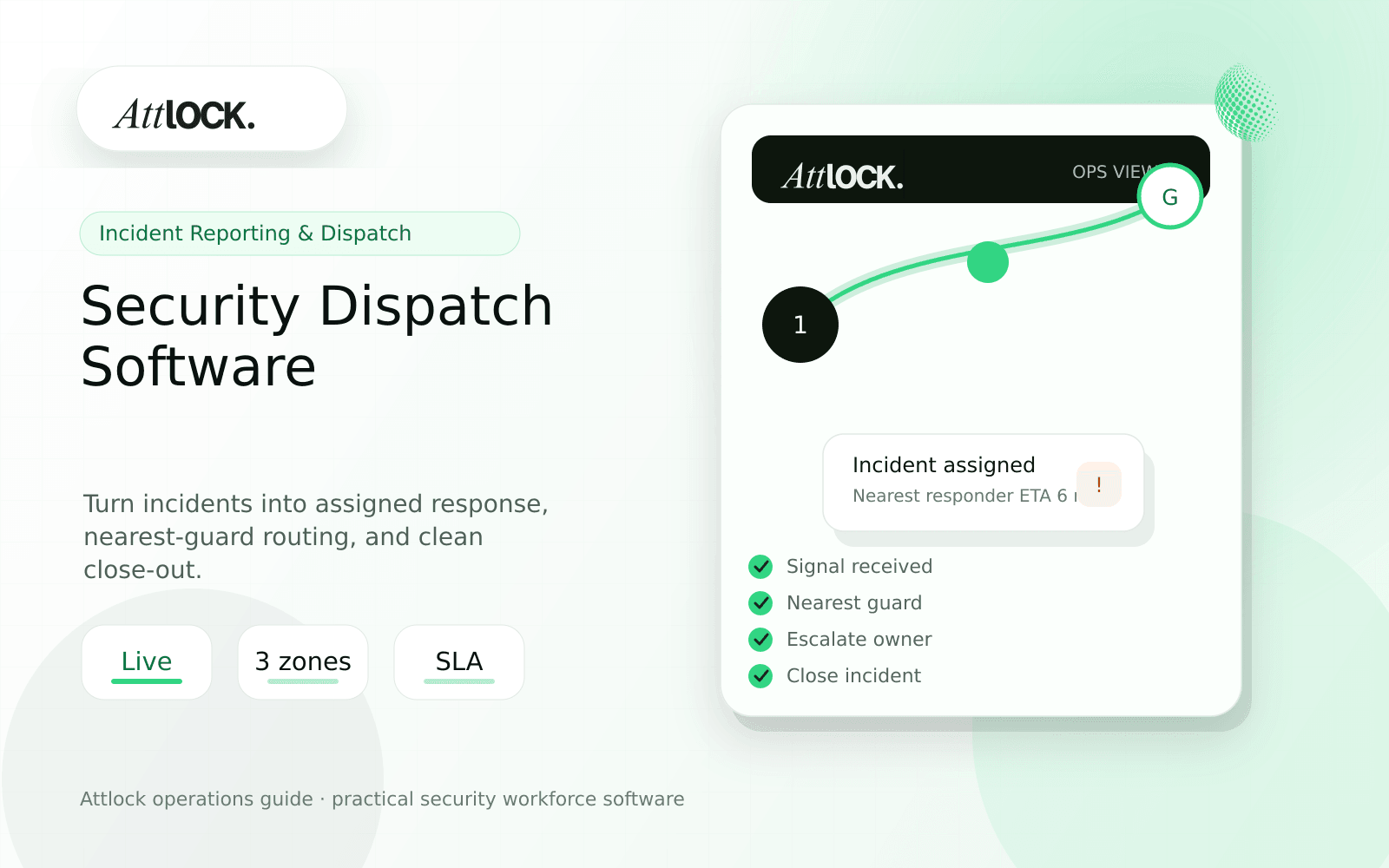
Attlock attacks this from both sides. NFC and QR patrol verification drives adherence to 93% with tamper-proof GPS scans and missed checkpoint alerts. The client portal gives clients live feeds, performance ratings, and branded PDF reports — cutting check-in calls by 50%. Fewer calls, fewer penalties, fewer lost contracts.
Cost Center #4: Billing Leakage — $130K+ Per Year
This one is particularly painful because it's money you've already earned and then fail to collect. Billing leakage happens when your invoicing system isn't connected to your actual time-and-attendance data. Guards work hours that don't make it onto the invoice. Overtime gets billed at regular rates. Shift differentials get missed. Holiday premiums get lost in the reconciliation.
CFOs at 500-guard operations estimate they lose $130K-$260K annually to billing leakage — but here's the catch: they can't prove exactly where it's happening because the data lives in different systems that don't talk to each other. They know the numbers don't match. They just can't pinpoint why.
TrackTik's billing module is widely criticized for exactly this problem. Users on G2 and Capterra report that it still requires manual reconciliation with QuickBooks or ERP systems, meaning enterprise operators lose 15-30 hours per billing cycle hunting for discrepancies. The platform that's supposed to fix billing leakage often perpetuates it.
Attlock's billing and invoicing is auto-generated directly from tracked hours. GPS-verified clock-in data flows straight to the invoice — Stripe-powered, zero manual intervention. When time data and billing data are the same data, disputes disappear.
$130K+ Annual Billing Leakage — Typical loss for 500-guard operations using disconnected billing and time systems
Cost Center #5: Compliance Exposure — Uncapped Risk
The four cost centers above have dollar figures you can model. This one doesn't — and that's what makes it the most dangerous. Compliance exposure is a liability with no ceiling.
Consider the regulatory landscape facing multi-state operators right now:
- **California AB 229** (Private Security Services Reform Act) — documentation and audit requirements with fines of $10K-$50K per incident
- **Illinois BIPA** — biometric data violations carrying class-action liability of $1,000-$5,000 per violation (buddy-punch biometric systems create exposure here)
- **HIPAA compliance** — required for healthcare facility security contracts, with breach penalties up to $1.5M per violation category
- **New York Security Guard Act amendments** — training documentation and licensing verification requirements with contract termination risk for non-compliance
Legacy tools can't automate guard licensing verification, training hour tracking, or use-of-force reporting across jurisdictions. You're relying on regional managers to manually maintain compliance documentation for hundreds of guards across multiple states. One missed training renewal, one undocumented incident, one failed audit — and the exposure dwarfs everything else on this list.
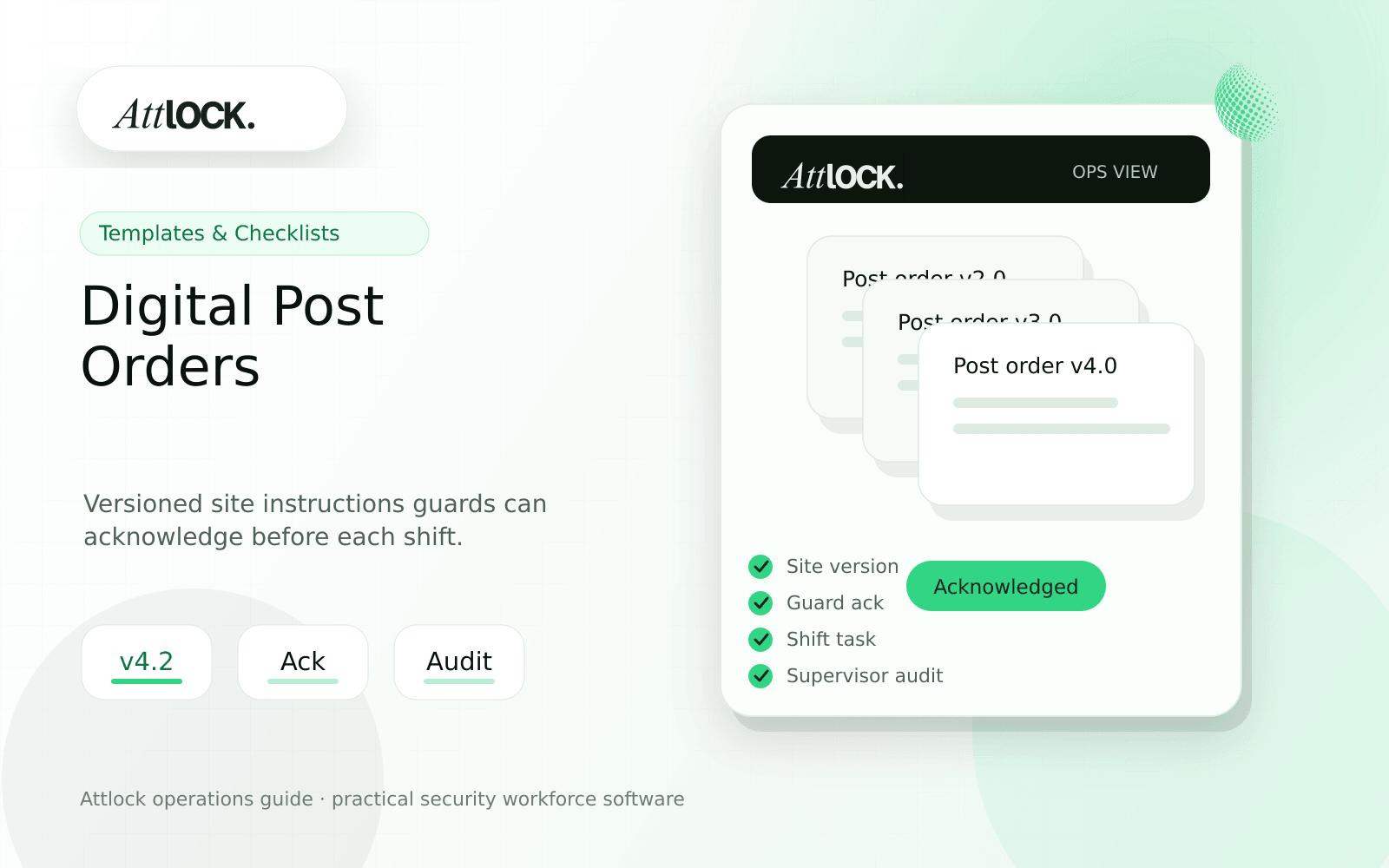
Attlock provides compliance reporting with exportable audit logs, digital post orders with version control and acknowledgment tracking, and incident reporting that captures multimedia evidence in under 60 seconds. For healthcare clients, Attlock is HIPAA-compliant. For government contracts, FedRAMP-ready. The compliance documentation that takes your team hours to assemble manually generates automatically.
The TCO Comparison: Attlock vs. TrackTik at Enterprise Scale
Let's put the full picture on the table. Here's what a 500-guard, 100-site operation actually pays over three years — not the number on the sales deck, but the total cost of ownership including setup, add-ons, support, and the hidden costs most vendors don't mention until you're locked into a contract.
| Cost Category | Attlock (Professional) | TrackTik/Trackforce Valiant |
|---|---|---|
| Pricing Model | Per-site (no per-guard fees) | Per-guard + module add-ons |
| Monthly Platform Cost (100 sites) | ~$6,500 CAD/month | $20,000-$40,000/month |
| Annual Platform Cost | ~$78,000 CAD | $240,000-$480,000 |
| 3-Year Platform Cost | ~$234,000 CAD | $720,000-$1,440,000 |
| Implementation Timeline | 1-2 weeks | 12-16 weeks |
| Implementation/Setup Fees | Included (Enterprise plan) | $15,000-$40,000 |
| Premium Support | 24/7 included (Enterprise) | $500-$1,500/month extra |
| Contract Lock-In | Month-to-month available | Multi-year, 60-90 day termination notice |
| Billing Module | Auto-generated from GPS hours | Manual reconciliation required |
| Cost When You Add Guards | $5/guard above plan limit | Price increases per guard |
| Transparent Public Pricing | Yes — attlock.com/pricing | No — requires sales engagement |
Read that last row again. Attlock publishes pricing at attlock.com/pricing. TrackTik requires you to sit through a sales process before you learn what it costs. In an industry plagued by opaque quoting, transparent pricing is a trust signal. If a vendor won't show you their cost structure upfront, ask yourself what the structure is designed to hide.
Over three years, the platform cost difference alone can exceed $500K. Add the operational savings from eliminating the five cost centers above, and the ROI math isn't close.
The Payback Period Math
Let's stack the annual savings conservatively:
- **Scheduling waste eliminated:** $93K
- **Buddy punching eliminated:** $260K
- **SLA penalties reduced:** $180K
- **Billing leakage recovered:** $130K
- **Vendor consolidation (replacing 5+ tools):** $80K-$200K in license fees
Total recoverable value: $743K-$863K per year. Against an Attlock annual cost of ~$78K CAD, the payback period lands at under 6 weeks. Even if you discount these numbers by half — assume your operation is somehow leaking only $350K — you're still looking at a payback period under 12 weeks and a first-year net benefit exceeding $270K.
💡 Build your own model: take your annual payroll, multiply by 2% (conservative buddy-punch rate), add your regional managers' scheduling hours at loaded cost, add last year's SLA penalties, and add estimated billing variance. That's your baseline. Most operators are shocked by the total.
Why Enterprise Operators Are Leaving TrackTik Now
TrackTik was the default enterprise choice for years. Then Trackforce Valiant acquired it in 2021. Since then, the pattern has been consistent across user reviews and operator conversations:
- **Price increases of 15-25% at renewal** with no corresponding feature improvements
- **Stalled product development** — the mobile experience hasn't meaningfully improved
- **Platform instability** — G2 and Capterra users report 3-5 hour outage windows and mobile app crashes
- **Support degradation** — standard tickets take 48-72 hours; sub-4-hour response requires a premium package at $500-$1,500/month
- **12-16 week implementation** at enterprise scale with $15K-$40K in professional services fees
The acquisition playbook is familiar in enterprise software: acquire the market leader, raise prices, cut R&D, extract margin. And operators are noticing. The window to switch has never been wider — and the switching cost has never been lower.
Attlock deploys in 1-2 weeks across 100+ sites, includes data migration from TrackTik or Silvertrac, offers dedicated account management and on-site training, and supports SSO/SAML for corporate identity management. The Enterprise plan includes API access for integration with your existing HRIS, payroll (ADP, Ceridian, Paylocity), and ERP systems. There's no proprietary hardware. No multi-year lock-in. No hidden setup fees.
The Contrarian Take: Your Software Isn't the Expense — Your Manual Processes Are
Most CFOs evaluate security management software as a cost to be minimized. That's the wrong frame. The platform fee — whether it's $6,500/month or $20,000/month — is not the number that matters. The number that matters is the $500K+ you're already spending on inefficiency, theft, penalties, and leakage. You're paying that cost right now. It's just hidden across a dozen budget lines where nobody's adding it up.
The right software doesn't add to your cost structure. It exposes the costs you're already absorbing and eliminates them. A platform like Attlock isn't a line item next to your other tools — it replaces 5+ tools while recovering half a million dollars in operational losses. The question isn't "Can we afford to switch?" The question is "Can we afford another year of not knowing where the money goes?"
Attlock is rated 4.8/5 by 150+ security companies. It's the only platform in the market that combines live dispatch, smart scheduling, geofenced time tracking, NFC patrol verification, incident reporting, client portals, automated billing, digital post orders, and AI analytics (coming soon) in a single system — at per-site pricing that doesn't punish you for growing.
If you're running 500+ guards across multiple sites and you're ready to see the actual numbers for your operation, book a demo at attlock.com/book-demo. If you want to test it yourself first, the 14-day free trial requires no credit card. And if you have technical questions about enterprise deployment, integration, or compliance, the Attlock Help Center has answers.
The $500K leak doesn't fix itself. But it can be fixed in under 6 weeks.
Frequently Asked Questions
How much does enterprise security guard management software cost?
Costs vary dramatically by pricing model. Per-guard platforms like TrackTik can reach $20K-$40K/month for 100-site deployments. Attlock uses per-site pricing starting at $65 CAD/site/month for Professional plans, meaning a 100-site operation runs approximately $6,500 CAD/month — with no per-guard fees that punish growth.
What is the ROI of switching from TrackTik to Attlock?
A 500-guard, 100-site operation typically recovers $500K+ annually by eliminating scheduling waste ($93K), buddy punching ($260K), SLA penalties ($180K), and billing leakage ($130K). With Attlock's per-site pricing saving $13,500+/month over TrackTik, most operators see full payback in under 6 weeks.
How long does it take to deploy Attlock at enterprise scale?
Attlock deploys across 100+ sites in 1-2 weeks, including data migration and on-site training. By comparison, legacy platforms like TrackTik typically require 12-16 weeks of professional services at $15K-$40K in setup fees. Attlock's cloud-native, mobile-first architecture eliminates the need for proprietary hardware.
How does per-site pricing compare to per-guard pricing for large security companies?
Per-guard pricing punishes growth. At 500 guards and $4/guard/month, you're paying $24K/year before add-ons — and costs rise every time you hire. Attlock's per-site model at $65/site/month caps your cost by location, not headcount. Add guards freely at $5/guard only above your plan limit.
What compliance requirements does enterprise security software need to meet?
Enterprise operators need SOC 2 compliance, HIPAA support for healthcare clients, FedRAMP-readiness for government contracts, and audit trail exports for state regulations like California AB 229 and Illinois BIPA. Attlock provides compliance reporting, exportable audit logs, and HIPAA-compliant data handling out of the box.